Migrant type: Resident to long-distance migrant
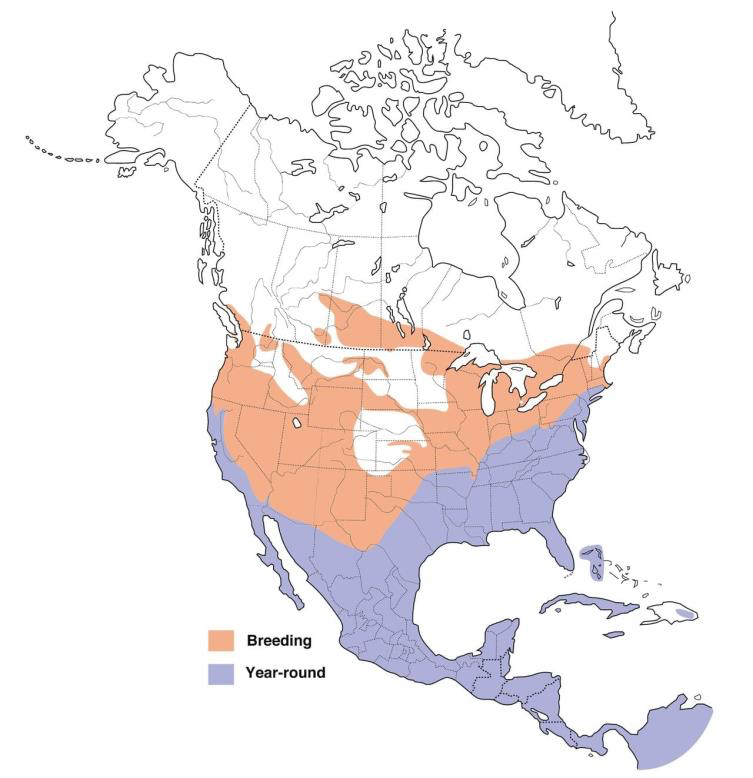
Some Turkey vultures in the southern U.S. are year-round residents. The vultures in the northeast migrate short distances south to North Carolina and Louisiana. Western birds migrate much farther south with more than a million vultures moving through Central America and some into Venezuela, Colombia, and Ecuador.
In Montana, these birds are some of the last to arrive in the spring and some of the first to leave in early September, late August. Their bald heads and legs/feet make it very difficult for them to handle the cold Montana winters.
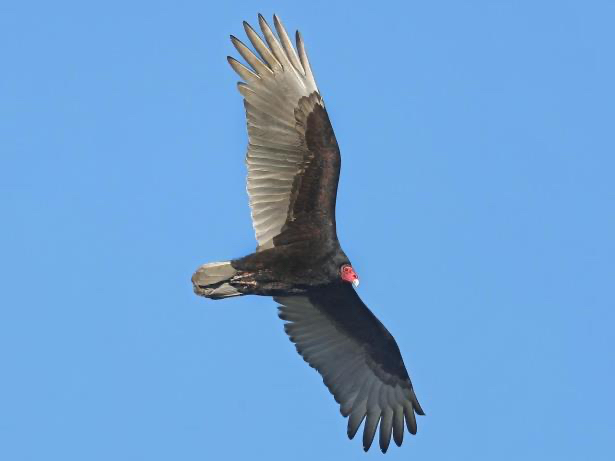
Turkey vultures are not commonly spotted in northern Montana, even in the spring and summer time they can be sparse. They have a large, 6-foot, wingspan that can look very similar to juvenile Bald eagles and Golden eagles. Vultures typically have their wings pushed up in a dihedral angle (“v” shape) while soaring and have a teetering flight with very few wingbeats. Under their wings, Turkey vultures have a grey coloring on their primary and secondary feathers. They also have a very small red head that can help to determine them from eagles.
They are commonly found around open areas like farm fields, country sides, roadsides, and suburbs. Due to their large size, they rely on warm pockets of air called “thermals” to help them soar without using lots of energy. They will wait for the ground to heat up and the heat to rise in the morning and then follow these circling pockets of air high into the sky. This will cause that circling behavior that is commonly seen from these and other soaring birds and can allow them to fly for up to 6 hours without having to flap their wings.
They can be seen in small groups while flying and roost in large numbers at night, which is uncommon for most raptor species.