
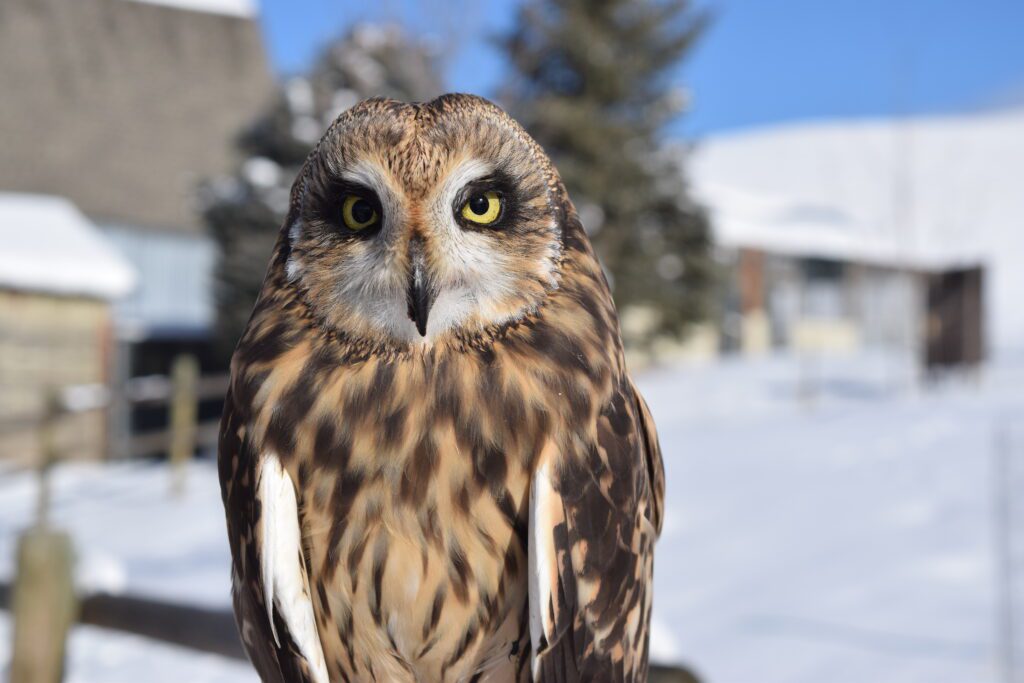
This open-country hunter is one of the most widely distributed owls globally and is frequently spotted during the day. While the ear tufts are often so short they may go unnoticed, the most prominent features are its black-rimmed yellow eyes, which stand out against its pale facial disk. These owls glide silently over grasslands on their broad, rounded wings, particularly at dawn and dusk. They rely on their keen hearing to hunt small mammals and birds. You can find Short-eared Owls in grasslands and open spaces, where they often perch on low trees or the ground. They are medium-sized, adorned with brown spots and buff and white markings on their upperparts. Their breast is heavily streaked with brown, while their chest and belly are light or buff in color.
Fun Facts
- Short-eared Owls are capable of covering significant distances across wide stretches of ocean. Observers have noted these owls swooping down on vessels located hundreds of miles offshore.
- The pueo (Asio flammeus sandwichensis), Hawaii’s sole native owl, is a subspecies of Short-eared Owl found across all the major islands of the chain. It is believed that pueos may have first come to the islands when Polynesians introduced owl prey, specifically the Pacific rat.
- This species of owl nests on the ground. The female Short-eared Owls often defecate on their eggs, the smell helps repel predators.
- They are active during the day (diurnal), soaring close to the ground over short vegetation. Their primary diet includes small mammals like mice and voles, but they also consume other birds, such as songbirds, gulls, and shorebirds.
